
Comparing two shelf-life programmes is hard because the documents are rarely the same shape: one supplier sends a summary, another sends raw checkpoints, a third sends nothing until asked. A weighted framework fixes that by separating the criteria from the paperwork. Decide what matters, put a weight on it, then score each supplier against the same list. The result is a decision a buyer can defend to a board, not a preference dressed up as analysis.
Key takeaways
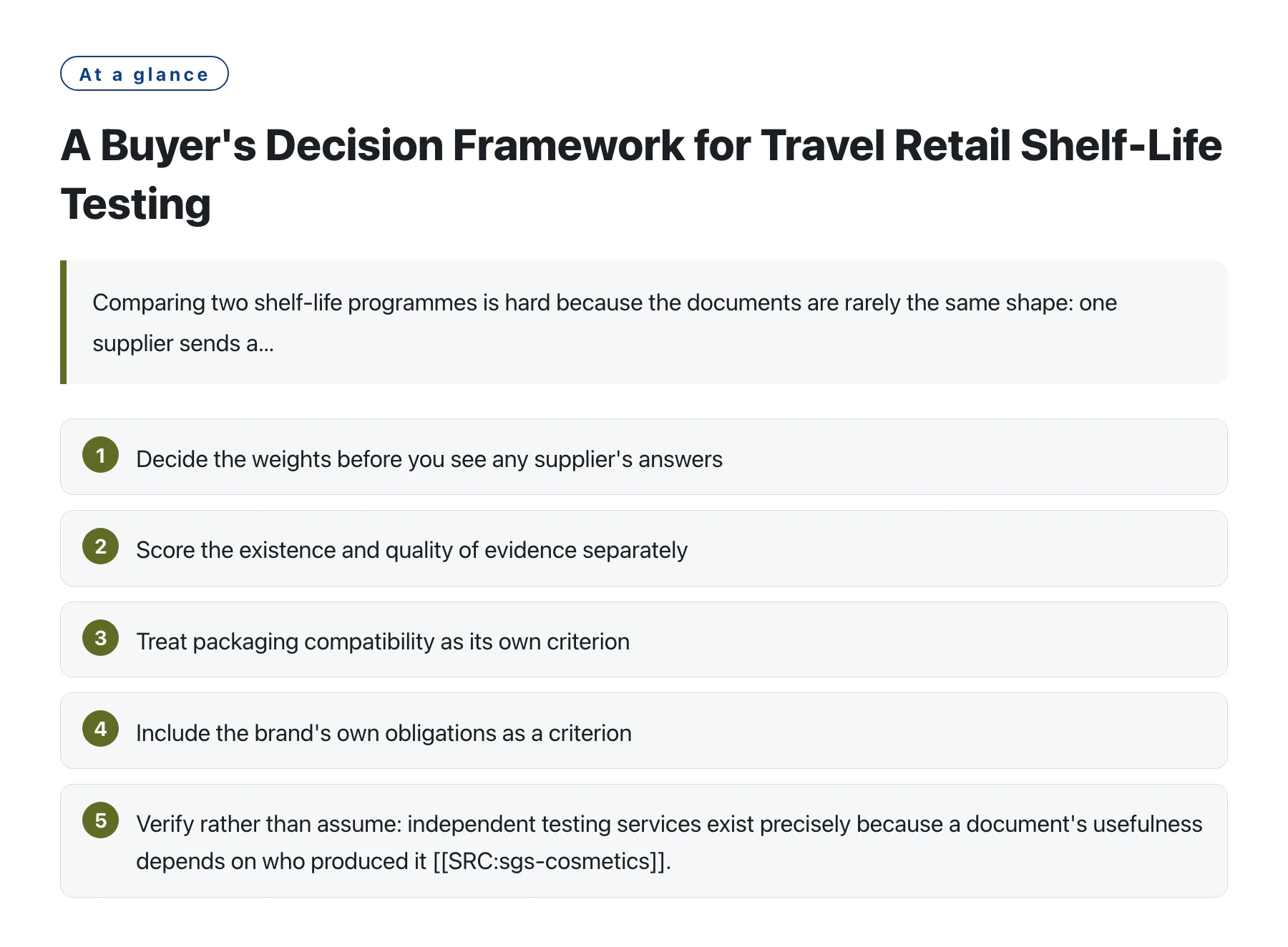
- Decide the weights before you see any supplier's answers, because weights chosen afterwards always fit the answer you already preferred.
- Score the existence and quality of evidence separately, since a supplier can have a testing programme and still produce a document that proves very little.
- Treat packaging compatibility as its own criterion, because it is the most common gap in otherwise strong stability documentation.
- Include the brand's own obligations as a criterion, since placing a cosmetic product on a market brings duties that stay with the company responsible for it even when the testing is delegated [1].
- Verify rather than assume: independent testing services exist precisely because a document's usefulness depends on who produced it [2].
Most supplier comparisons collapse into a conversation about price, with technical capability reduced to a yes or no. That works until something goes wrong, at which point the buyer has no record of why the supplier was chosen.
The framework below is short on purpose. Six criteria, a weight for each, and a scoring rule that forces a written reason for every score. It takes about an hour per supplier once the documents are in hand.
Set the weights first
Write the weights down and date them before requesting anything from a supplier. The order matters because a weight set after the fact is not a weight, it is a rationalisation. Six criteria weighted to total 100 is enough granularity for a decision without turning into a scoring exercise nobody maintains.
The two criteria buyers most often forget are packaging compatibility and document ownership. The first is where stability programmes fail in practice, because bulk liquid can be perfectly stable while the assembled pack is not. The second decides whether the brand can answer a question about its own product in two years' time without going back to the supplier.
Six criteria, with what a strong answer looks like
| Criterion | Weight | What a strong answer looks like |
|---|---|---|
| Protocol completeness | 20 | Chamber conditions, tolerances, checkpoints and sample source stated in full |
| Packaging compatibility | 20 | Weight-loss, leakage and function data on filled units in the exact pack to be sold |
| Observation quality | 15 | Raw checkpoints recorded per sample, including fields that passed |
| Specification linkage | 15 | Evidence tied to a version-controlled formula and component list with a named approver |
| Document ownership | 15 | Brand receives the report and the underlying data, with reuse rights stated |
| Independence and auditability | 15 | In-house work clearly labelled, third-party work available where risk justifies it |
Score each criterion from zero to five, multiply by the weight, and write one sentence explaining every score below three. The sentences are the point of the exercise.
Reading the scores
A high total with one zero is a warning, not a pass
A supplier can score well on documentation and still have no packaging data at all. That single gap is the one most likely to cause a travel retail problem, because the pack is where the product meets a real environment. Treat any criterion scored at zero as a gate rather than as a deduction, and either resolve it before the order or price the risk explicitly.
The same applies to document ownership. A programme that cannot be transferred leaves the brand dependent on a relationship that may end, which is a commercial risk rather than a technical one.
Separate capability from presentation
Suppliers with strong systems often present them poorly, and suppliers with weak systems often present them well. The framework is designed to score the substance rather than the layout, which is why the observation-quality criterion looks for raw checkpoints rather than a well-designed summary page.
A practical test is to ask one question whose answer requires the supplier to go back to a record. How many units of the approved sample are retained, and where? A supplier with a real system answers in a sentence. A supplier without one answers in a paragraph that does not contain the answer.
Where the weights change for travel retail
For a domestic launch, observation quality and specification linkage usually carry more weight than independence, because the feedback loop is short and a problem can be corrected quickly. For travel retail, packaging compatibility and document ownership deserve more, because the stock is committed early, often non-returnable, and consumed far from the factory.
Adjust the weights to the channel rather than reusing one set across a portfolio. A framework that produces the same ranking for a subscription line and an airport listing is measuring the suppliers rather than the fit.
Using the framework without turning it into a ritual
The output should be a ranking with three named risks per supplier, not a score table filed away. If the top two suppliers are within a few points of each other, the tie is usually broken by the risk list rather than by the total, because one of them will have a gap the brand can live with and the other will have a gap it cannot.
It is also worth checking what a supplier publishes about its own process before the scoring begins, so the conversation starts from specifics rather than introductions. A manufacturer's official website is a reasonable first stop for that, provided it is read as a description of intent rather than as evidence.
Where the framework keeps paying is in the second order, when the same criteria are re-scored without warning. A supplier that has quietly stopped retaining samples or stopped recording observations will show up in the comparison, and that early signal is worth more than the original decision.
For a premium assortment, one criterion deserves a closer reading than the summary allows, because the tolerances that matter at a high price point are tighter. Material on fine fragrance manufacturing is a useful companion when the weights include appearance, colour and spray quality alongside the standard checks.
Finally, keep the scoring file even after the supplier is chosen. When a later disagreement arises about evidence, the original reasons are the best available record of what was verified and what was assumed, and they are far cheaper than reconstructing a decision from emails.
If a structured checklist of the questions to put to a shortlisted supplier would help, a walkthrough covering due diligence on a perfume manufacturer maps closely onto the six criteria above and is a quick way to test whether the weights you set are the weights you actually care about.
Score no more than six criteria. Every criterion added beyond that dilutes the ones that decide the outcome, and a framework nobody maintains is worse than no framework.
Sources
- European Commission: Cosmetics in the EU —— The European Commission's overview of EU cosmetics rules, including the responsible person, product information file and safety report requirements.
- SGS: Cosmetics, Personal Care & Household Testing —— Testing, inspection and certification services for cosmetics and personal care, including microbiological, stability and safety testing aligned with cosmetics GMP.
Frequently asked questions
How many suppliers should go through the framework?
Two or three is usually enough. More than that and the marginal information is small compared with the time spent scoring documents that are not comparable.
Should price be one of the criteria?
Keep price separate. Score technical fit first, then compare price only among suppliers that clear the gates, otherwise a cheap quote can mask a missing pack study.
What if a supplier refuses to share raw observation data?
Treat it as a scored gap rather than an immediate rejection, and ask what it would take to share it. The answer is more informative than the refusal.
Is third-party testing always better?
No. In-house work is normal and often competent. Third-party confirmation matters where the risk is high or where a listing buyer will ask who produced the result.
When should the framework be re-run?
Before each significant order and after any change to the formula, the pack or the destination markets, since all three change what the evidence needs to cover.