
OEM Jewelry Manufacturing Timelines in Days and Weeks
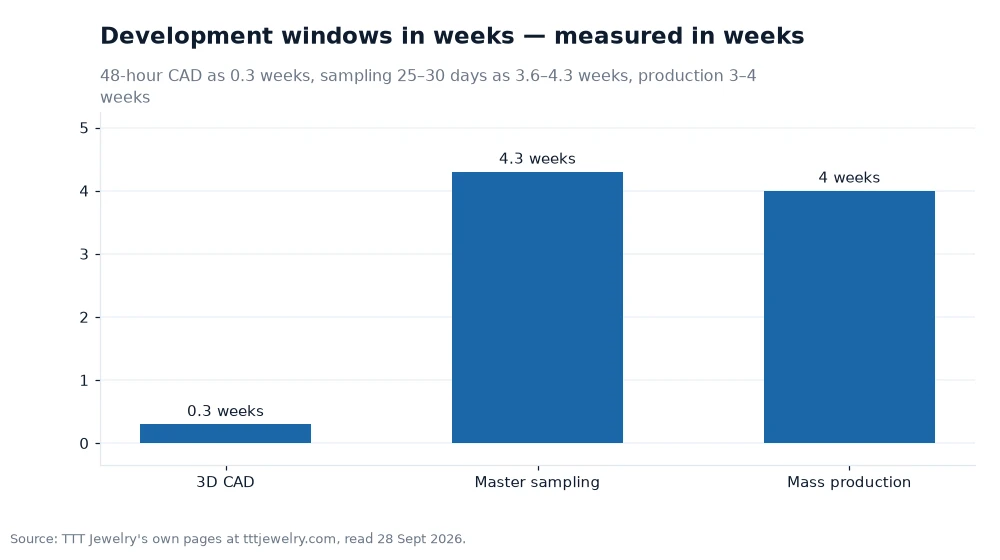
Published development windows arrive in mixed units, and that is where launch calendars go wrong. Read as weeks, the same figures are 0.3 weeks of 3D CAD, 4.3 weeks of master sampling and 4 weeks of mass production — about seven to nine weeks in total before your own approval time is added.

Key takeaways
- Under 48 hours of CAD is roughly 0.3 weeks; 25–30 days of sampling is 3.6 to 4.3 weeks.
- Mass production is published at 3–4 weeks, so a first order sits near seven to nine weeks of factory time.
- Only three of the eight factory steps carry a published duration; the rest run inside those windows.
- The OEM/ODM route also covers 24-hour responses and a dedicated project manager, which is how approval time is kept short.
Why published timelines arrive in mixed units
CAD is quoted in hours because it is screen work measured in days. Sampling is quoted in days because it involves a physical master and several bench operations. Production is quoted in weeks because it is planned by the batch.
None of those units is wrong, but they cannot be compared until they are converted. A brand building a launch calendar has to convert everything at once, and the conversion is simple: 24 hours to a day, 7 days to a week.
Forty-eight hours is 0.3 weeks, and that matters
Two days of CAD sounds like nothing, and as a share of a schedule it is almost nothing. It still decides the other stages, because the drawing is the instruction the master sample is built from. Getting the dimensional sign-off late by a week pushes sampling and production back by the same week.
So the useful way to read the 48-hour figure is as a deadline on your own desk rather than on the factory's. The modelling turnaround is published; the review turnaround is not, and on a first order it is the simplest week to lose.
Twenty-five to thirty days, read as weeks
Divide the sampling window by seven. Twenty-five days is 25 ÷ 7 ≈ 3.6 weeks; thirty days is 30 ÷ 7 ≈ 4.3 weeks. That block covers the physical master: the 3D wax print, mould casting, setting the stones, gloss polishing and electroplating to spec.
Four to five weeks for a first physical sample is the part of the schedule most often underestimated, because it contains five separate bench operations in sequence and each one has to finish before the next begins. It is also the stage where a design that is genuinely hard to make reveals itself.
Production weeks, and the reorder calendar
Bulk production is published at 3–4 weeks after sample approval, with the actual length depending on batch volume and design complexity. For a first order that window is mostly about volume. For a reorder it is also about whether the specification is on file, because a repeat run does not need a new sample.
The practical consequence for planning is that a reorder can be placed against the production window alone — 3 to 4 weeks — instead of the full development cycle of roughly seven to nine. Selling season preparation should therefore be dated backwards from the shipping date, not forwards from the order date.
Where a week disappears without anyone noticing
Approval gates belong to the buyer. Between CAD sign-off and sample approval there are two decisions that only your side can make, and both are quoted as zero hours by the factory because they are not factory work. Add stone approval, artwork for a foil-stamped gift box and a barcode label, and a first order can sit idle for a week with every published window being met.
The documented countermeasures are mundane: a 24-hour response window, a dedicated project manager and a written step list. Used properly, they turn approvals into scheduled events instead of loose ends.
Building a launch date backwards from shipment
Start with the date the goods are needed in a warehouse. Take off 3–4 weeks for production, then 25–30 days for sampling, then two days for CAD, then your own approval time at each of the three gates. What remains is the latest date to send sketches.
Then check the result against the factory's own calendar, not against optimism. A 24-hour response time shortens the gaps between gates; it does not shorten the gates themselves, and no amount of answering quickly will make a wax print set faster.
| Stage | As published | In days | In weeks |
|---|---|---|---|
| 3D CAD modelling | Under 48 hours | 2 | 0.3 |
| Master physical sampling | 25–30 days | 25–30 | 3.6–4.3 |
| Mass production | 3–4 weeks | 21–28 | 3–4 |
| Minimum per design | 50 / 100 / 100+ pcs | — | — |
The paperwork that shortens the conversion
Two documents decide how confidently a calendar can be built. The step list tells you which operations the factory owns and in what order, so a delay can be traced to a stage rather than to a vague sense that things are slow. ISO 9001:2015 is the quality management system behind that list, which means the sequence is documented and repeated rather than improvised per order.
The second document is the approval record. Every gate needs a named approver and a date, because a timeline with three unnamed gates is really a timeline with three unmeasured delays. Brands that would rather fix the dates before anything else can start your project with a written schedule attached, then use the 24-hour response window and the dedicated project manager to keep the gates moving.
Worked example: adding the windows up in weeks
Convert each stage and add. 3D CAD is 2 ÷ 7 = 0.29, which rounds to 0.3 weeks. Sampling is 25 ÷ 7 = 3.57 at the fast end and 30 ÷ 7 = 4.29 at the slow end. Production is 3 weeks or 4 weeks as quoted.
Fast end: 0.3 + 3.6 + 3 = 6.9 weeks. Slow end: 0.3 + 4.3 + 4 = 8.6 weeks. That is the published seven-to-nine-week band, and it excludes your approval time at CAD, sample and artwork stages.
Adding one week of buyer delay at each of the three gates produces 9.9 to 11.6 weeks on the same factory, which is the single most common reason a first order misses a season.
Frequently asked questions
How long is the whole process from sketch to shipment?
About seven to nine weeks of factory time: under 48 hours for CAD, 25–30 days for the master sample and 3–4 weeks for production, plus your own approval time.
Why is sampling quoted in days and production in weeks?
Sampling is a sequence of bench operations with a physical master in the middle, while production is planned by the batch, so each stage is quoted in the unit the factory actually uses.
Does a reorder take as long as the first order?
No. With the specification and sample already approved, a repeat run sits inside the published 3–4 week production window.
Sending a project in with the dates already checked
Put the three converted windows and the minimums in one message before anyone talks about a launch date. That turns a scheduling conversation into a specification conversation, which is what the factory's in-house factory steps are written around, and it is the same ordering a wholesale buyers' page expects when a first order is sized against a season.
Where the numbers come from — laser engraving for logos together with the confidentiality terms and the approved-sample benchmark — is the factory's own site at tttjewelry.com itself, read in full on 28 Sept 2026. The percentages quoted above are my own construction, while the source figures stay the client's[1].